


The holidays are coming, and for indie authors, that means more than festive decorations, endless shopping emails, and the occasional questionable fruitcake. It means opportunity. Holiday sales are one of the biggest seasonal marketing opportunities for indie authors, but making the most of them takes more than offering a Black Friday discount. The secret is that the holiday shopping season actually stretches from mid-November through mid-January, and there are 3 distinct timeframes, each with a different strategy. This gives authors nearly two months to reach readers, promote books, and build momentum for the new year.
TL;DR: How Should Authors Prepare for Holiday Sales?
The best holiday sales strategy for indie authors is to plan marketing around three shopping periods:
- The Turkey 10 (late November): This is the period around Black Friday/Cyber Monday. During this period, you should focus on discounted eBooks, email promotions, and deals.
- The Holiday Hustle (December): Promote giftable books. Think about your physical inventory (POD and that box in your garage), including paperbacks, hardcovers, signed copies, and special editions. Plan around shipping deadlines.
- The Golden Window (December 26–mid-January): From a sales perspective, January starts on December 26. Reach readers spending gift cards, capitalize on New Year’s reading goals, and test whether lower advertising costs create opportunities to scale.
Our biggest recommendation? Don’t stop marketing. This two-month period offers some of the best opportunities to drive sales all year. Some of the most promising opportunities for authors arrive after the presents have been opened.
Table of Contents
What are the dates this year?
Turkey 10: How to Prepare for Black Friday and Cyber Monday
Holiday Hustle: How to Sell More Books During December
Golden Window: Why Post-Christmas Sales Matter
How Can Indie Authors Build a Holiday Sales Marketing Plan?
FAQs
Your Holiday Sales Checklist: What Should You Do Next?
What are the dates this year?
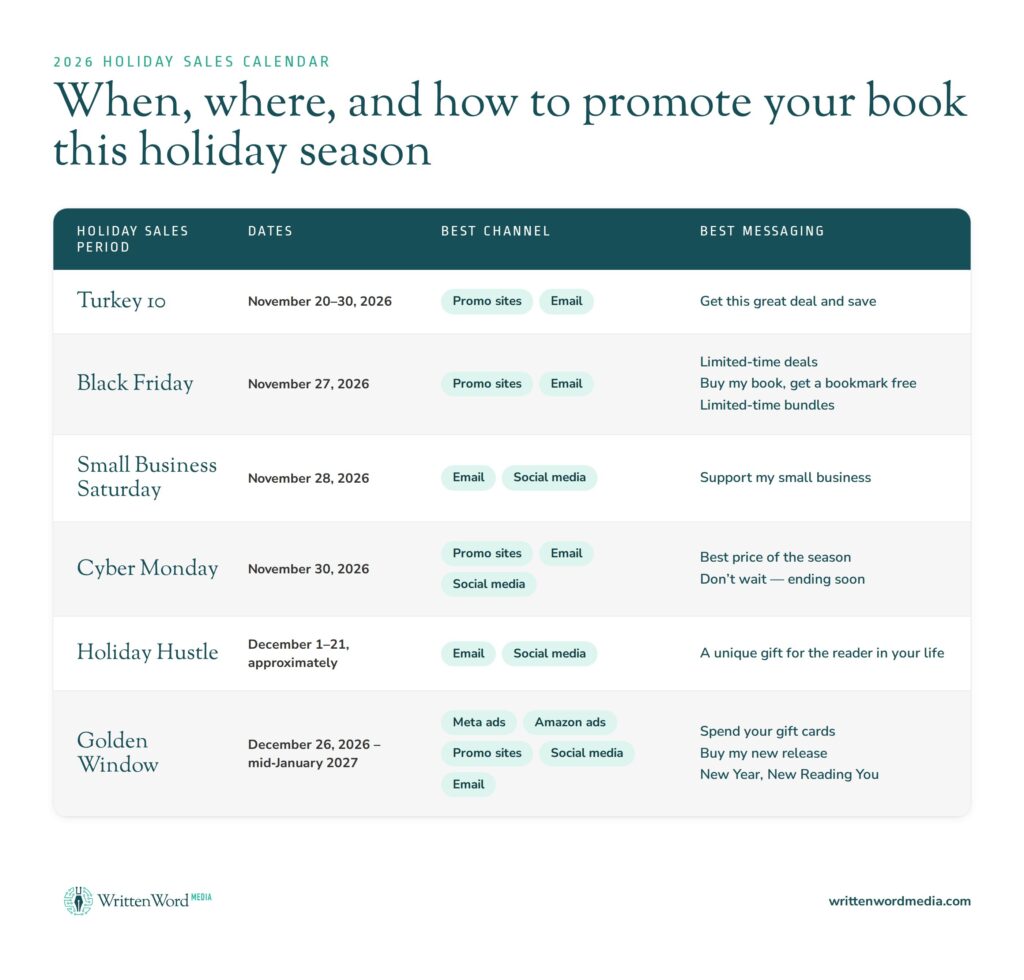
At Written Word Media, we divide the holiday shopping season into three distinct phases, each with its own reader behaviors and marketing strategies. For the 2026–2027 holiday season, here are the important dates:
| Holiday sales period | Dates | Best marketing opportunity |
| Turkey 10 | November 20–30, 2026 | Discounted eBooks and email promotions |
| Black Friday | November 27, 2026 | Limited-time book discounts |
| Small Business Saturday | November 28, 2026 | Supporting independent authors |
| Cyber Monday | November 30, 2026 | Online book promotions |
| Holiday Hustle | December 1–21, approximately | Print books and giftable editions |
| Golden Window | December 26, 2026–mid-January 2027 | eBooks, gift cards, new releases, and reader acquisition |
Note: The Turkey 10, Holiday Hustle, and Golden Window are Written Word Media’s planning frameworks, not the official retail holidays. The important distinction is that reader behavior changes throughout the season and you want to take advantage of that by changing your marketing techniques. In November, people are looking for deals. In December, they’re searching for gifts. After Christmas, many are shopping for themselves again. Understanding those differences helps you promote the right books at the right time.
The Turkey Ten: How Should Authors Prepare for Black Friday and Cyber Monday?
Black Friday and Cyber Monday have evolved from two individual shopping days into an extended holiday-deals period. Consumers are primed to hunt for discounts, compare prices, and buy what they’ve been putting off. In short, it’s buying season!
Transition spend to fixed-cost marketing like promo sites.
During the Turkey Ten, e-commerce retailers are pouring money into advertising. That competition can make Facebook Ads, Instagram Ads, and other auction-based advertising more costly. Competing with that is expensive. Higher advertising costs don’t necessarily mean your campaigns will perform poorly, but they can make profitability harder to maintain. We recommend dialing down (but not turning off) your Meta ads, and reallocating that cost to marketing techniques that have a fixed cost. Written Word Media’s promos are the same price all year long, and even when every retailer is bidding for ads, our prices won’t change. For example, Written Word Media’s Bargain Booksy connects readers with discounted eBooks, while Freebooksy helps authors promote free eBooks to readers looking for their next read. You can also coordinate several promotions into a Promo Stack, creating multiple opportunities for readers to discover your book during a limited-time discount.
Why are discounted books especially appealing during the Turkey 10?
During this period, people expect deals. They will see discounts everywhere they go, and this is the time to lean into it! People are ready to buy, but they want to see that deal first. Many consumers hold back budget in expectation that they will spend it during this period when prices are low. Some Ideas on what discounts to run:
- Discount an eBook to $0.99 or $2.99, where your pricing and royalty structure allow.
- Promote the first book in a series to introduce new readers to your backlist.
- Create limited-time offers with clear start and end dates.
- Consider free eBook promotions when your goal is discoverability or series read-through.
- Schedule email promotions before popular holiday dates fill up.
A discounted eBook may be exactly what a reader wants between buying a new television and ordering another pair of fuzzy socks.
How often should authors email readers during holiday sales?
You have our permission to send a lot of email during this time. Consumers are expecting deals, and expecting emails. The reader tolerance for email marketing is sky high during this period. You could easily email once a day, for a week and it would not be too much. Do whatever is comfortable for you, but know you have a lot more wiggle room than at other times of the year. Here’s a playbook that would be reasonable during this time, assuming you have a discount running from Friday through Monday.
- Monday Nov 23: Announce your Black Friday book discount is coming soon.
- Wednesday Nov 25: Wish your readers in the US a Happy Thanksgiving and remind them about the sale on Friday.
- Friday, Nov 27: In the morning, tell your fans the sale is today, and send the offer.
- Saturday, Nov 28: Keep the sale going through the weekend. Email your readers to tell them today is Small Business Saturday and you are a small business. Humbly ask for their support.
- Monday Nov 30: Send a final Cyber Monday reminder before your offer ends.
This is 5 emails in one week, and at no other time during the year do you have license to send this much email. Remember you are not being annoying! Readers WANT deals during this time. Keep each email respectful and give readers a clear reason to open it. One important caveat: If you haven’t contacted your mailing list in six months, suddenly emailing daily may create some confusion and unsubscribes. Start right away to send a few soft emails to reintroduce yourself before increasing your frequency during the Turkey Ten. What to avoid during the Turkey 10: Launching expensive, untested ad campaigns, focusing exclusively on list building, or waiting until Thanksgiving week to schedule promotions.
Holiday Hustle: How Can Authors Sell More Books During December?
What types of books make the best holiday gifts?
Readers aren’t just hunting for deals anymore. They’re searching for gifts for friends and family. Often a great gift feels personal, thoughtful, and memorable. eBooks still perform because eBook readers never stop, but physical books have an advantage when it comes to gifting. A paperback or hardcover is something a shopper can wrap, place under a tree, and give to someone they love. And special editions? Those can make a particularly memorable gift. Consider highlighting:
- Signed paperbacks or hardcovers for devoted readers.
- Collector’s editions with distinctive covers or sprayed edges.
- Complete series sets for readers who love immersive fictional worlds.
- Illustrated or premium editions for fans of beautiful books.
- Personalized copies for shoppers seeking something meaningful.
You don’t need an elaborate collector’s edition to participate. Even a standard paperback can become a thoughtful gift when you explain who it’s perfect for.
How to Market Books during Gifting Season
Remember, people are thinking about buying for others during the season. Instead of saying, “Buy my fantasy novel,” try anchoring your reader to the gifting season. You can use the Shopping for someone framework in your emails or ads to get this idea across:
- Shopping for someone who loves dragons?
- Shopping for someone who loves to read?
- Shopping for someone who is impossible to buy for?
The difference is subtle but powerful: You’re helping someone solve a gift-giving problem, not asking them to buy a book.
How can authors prepare print books for holiday sales?
If you currently publish only eBooks, the holiday season may be a good reason to explore print-on-demand publishing. Services such as Amazon Kindle Direct Publishing, IngramSpark, and Lulu offer print publishing options without requiring authors to maintain large inventories. Print-on-demand also lets you continue selling physical copies after the holiday season. Before December, check your:
- Print book availability and product listings.
- Cover files, formatting, and proof copies.
- Retail pricing and royalty margins.
- Printing, fulfillment, and shipping timelines.
- Direct-sales inventory, if applicable.
Pay special attention to shipping cutoffs. If a customer orders a book as a Christmas gift, they need enough time for printing, delivery, and wrapping. Communicate deadlines clearly, and avoid promising Christmas delivery unless your fulfillment provider can support that promise.
Are in-person holiday markets worth it for self-published authors?
If you have physical inventory and enjoy connecting with readers, then yes, they are definitely worth it. Local holiday markets, craft fairs, bookstore events, and community shopping festivals put you directly in front of people looking for gifts. You can sign copies, explain your books, and help shoppers choose a title. A simple question like “Who are you shopping for?” can open the door to a sale. Remember, everyone is walking around looking for a gift, and your book can solve their problem. Holiday events also let you sell existing inventory without paying individual shipping costs. If you happen to have a box of books sitting in a corner of your garage, this can be a great way to unload that inventory. Just account for vendor fees, travel, payment processing, and the time you’ll spend at the event.
The Golden Window: Why Is the Post-Christmas Golden Period So Important?
Do people still buy books after Christmas?
Absolutely. So much. And this is one of the most overlooked opportunities in an indie author’s marketing calendar. Written Word Media calls the period from December 26 through mid-January the Golden Window. Three factors make this period particularly interesting for authors.
- Readers have gift cards to spend.
Many shoppers receive Amazon or other retailer gift cards during the holidays. Once Christmas is over, those gift cards can turn into purchases of eBooks, audiobooks, and print books. Purchasers are more liberal with spending money that came as a gift compared to spending money they have to earn.
- Readers are setting New Year’s goals.
January brings renewed interest in healthy habits, self-improvement, and personal goals. For many readers, that includes reading more books. Spending more time scrolling TikTok and watching TV are not on anyone’s January resolutions, but reading often is. Authors can tap into this motivation with messages like: “New year. New reading goal. Your next favorite book starts here.” Nonfiction authors can connect their books to specific goals, while fiction authors can emphasize entertainment, relaxation, and spending more time reading.
- Advertising competition often decreases.
Once the major holiday shopping rush ends, retailers pull back and reduce their advertising budgets. That can create opportunities for lower advertising costs. This is a great time to increase your spending on platforms like Facebook or Google. Written Word Media’s Reader Reach products sees especially strong results in January. Reader Reach is a great option for authors who want to take advantage of the golden period, but don’t want to manage their own ads. However, the size and timing of any decrease will depend on the platform, audience, and year. Lower costs aren’t guaranteed. The key is to watch your own campaign performance rather than assume every January click will be less expensive.
Should authors launch new books in January?
January can be a terrific time to launch a new book, especially when the alternative is releasing during the crowded December gifting period. With lower advertising costs and a renewed interest in reading, it’s prime time for new releases. If you’re planning a January launch, prepare your book description, cover, retailer pages, email announcements, and advertising materials before the holidays. Then consider combining your launch with a NewInBooks marketing campaign to help introduce your release to interested readers. We are big proponents of experimentation, but January is the time to play your greatest hits, not run crazy experiments. If you have ad campaigns that have worked in the past, renew them and add budget. Save experiments for February. Rather than starting five unfamiliar campaigns at once, consider increasing investment in the ads, audiences, and messaging that have already delivered results. What to avoid during the Golden Window: Turning off all marketing on Christmas Eve, January starts on Dec 26.
How Can Indie Authors Build a Holiday Sales Marketing Plan?
You don’t need a massive marketing budget or a complicated spreadsheet to make holiday sales work for your author business. Start with one meaningful action for each shopping period.
What does a realistic holiday marketing plan look like?
Imagine an indie fantasy author with a completed trilogy, an email list of 1,500 subscribers, and a $300 seasonal marketing budget. Here’s one possible approach:
| Period | Marketing action | Example budget |
| Turkey 10 | Discount Book 1 and schedule an email Promo | $100 |
| Holiday Hustle | Promote signed paperbacks through email and organic social posts | $0 in advertising |
| Golden Window | Run an existing, proven Facebook Ads campaign with a higher budget | $200 |
| Total | $300 |
The above is an Illustrative scenario. You can go bigger or smaller, but our recommendation is to plan ahead.
When should authors start planning holiday promotions?
Ideally, begin preparing in October or early November. Popular promotional dates can fill up, and Written Word Media promotions often sell out during this time. Use this simple timeline: October–early November: Choose books, set budgets, verify pricing eligibility, and schedule promotions. Mid–late November: Prepare email campaigns, update book listings, and launch planned discounts. Early December: Shift messaging toward giftable editions and physical books. Late December–mid-January: Reengage readers, promote new releases, and increase marketing budgets. If you’re starting late, don’t panic. Focus on the next available opportunity rather than trying to recreate a campaign you missed.
FAQs
Do Holiday Book Sales Continue After Christmas?
Yes! Holiday book sales don’t end on December 25. The period from December 26 through mid-January can be especially valuable for indie authors. Readers are spending holiday gift cards, setting New Year’s reading goals, and looking for their next great book. Advertising costs may also decrease after the holiday shopping rush, creating opportunities for authors to reach more readers efficiently.
Is Black Friday a good time to discount an eBook?
Yes. Black Friday is a strong opportunity to test discounted eBooks because shoppers are actively looking for deals. Authors should evaluate royalties, promotion costs, and potential series read-through before choosing a price.
When is the best time to promote a book during the holidays?
It depends on your goal. Late November is well suited to discounts, early December to giftable print editions, and late December through mid-January to gift-card shoppers, reading resolutions, and potentially more cost-effective advertising.
Should authors run Facebook Ads during holiday sales?
Authors can run Facebook Ads throughout the season, but should monitor costs closely. Advertising competition can intensify around Black Friday and Cyber Monday. Post-Christmas campaigns will offer better economics, depending on audience and market conditions.
Is January a good month for self-published authors to release books?
Yes. January can be a good launch month because readers may have new reading goals, holiday gift cards, and time to discover new titles. Authors should still consider genre trends, audience behavior, and their own launch readiness.
Your Holiday Sales Checklist: What Should You Do Next?
The holidays don’t have to mean doing everything at once. At Written Word Media, we recommend choosing one achievable marketing action for each of the three shopping periods. That gives you a manageable plan without turning the busiest season of the year into another full-time job. And remember: The holiday marketing season doesn’t end when the wrapping paper hits the recycling bin. It may just be getting to the good part.
Ready to Make Your Holiday Marketing Plan?
Written Word Media helps indie authors connect with readers through effective email promotions and advertising services. Whether you’re discounting an eBook for Black Friday, planning a Promo Stack, or preparing a January campaign, we’re here to help you find the right approach for your goals. Make the Most of Every Holiday Sales Opportunity From Black Friday discounts to the Golden Window, Written Word Media can help you reach readers throughout the holiday season. Explore our email promotions and find the right dates for your next campaign. Schedule a Promo.
Keep Reading
For more book marketing ideas, explore:
- Freebooksy — Free eBook promotion opportunities.
- Bargain Booksy — Discounted eBook promotions.
- NewInBooks — Book discovery and new-release marketing.
Let’s talk holiday marketing! Which shopping period are you most excited about: Black Friday, December gifting, or the Golden Window? Share your plans in the comments. And if you know another indie author who’s wondering how to prepare for holiday sales, share this guide. A little holiday marketing knowledge is a gift worth giving.